Mass determines inertial and gravitational properties. In my previous post, I described a model that clearly explains the gravitational attraction due to the Higgs field. But I didn’t write anything about the inertial component.
Gravitational manifestation
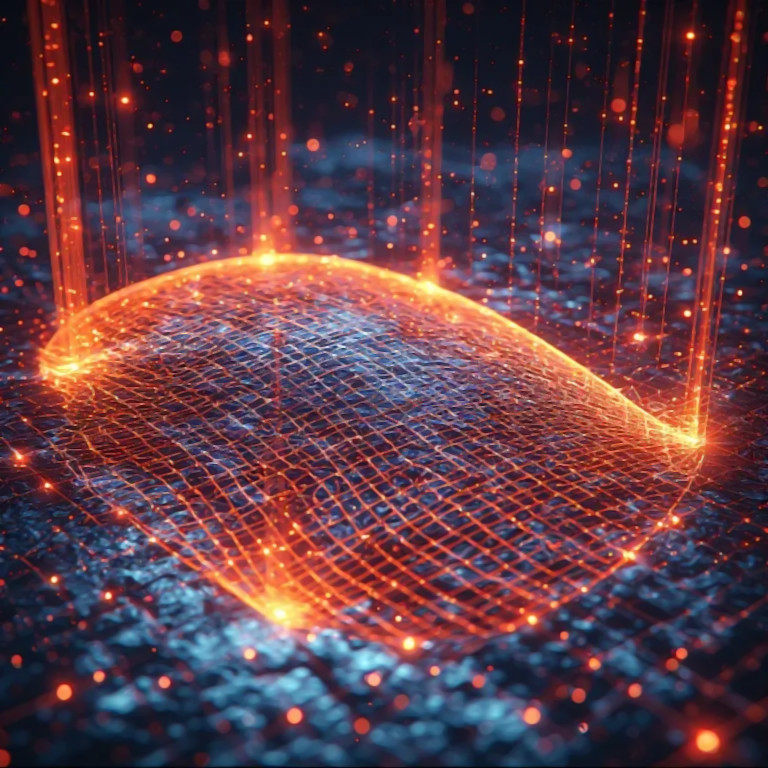
Again, it’s worth noting that one must be very careful before finding matches between a model and actual quantum processes. But since our brains aren’t evolved to calculate quantum effects, it’s easier to start from a clear analogy than from mathematical formulas. That’s why I like this model more and more (while I always keep in mind that this is just an analogy). It seems that just as an elastic network strives to return to its original state, the Higgs field strives to minimize disturbances in it. This is what causes gravitational attraction. Bringing massive objects closer together reduces the field’s “tension.”
Inertial manifestations
Popularizers often try to explain this aspect of the Higgs field. They sometimes draw analogies about how difficult it is to move when you fall through deep snow. Or they draw an analogy about the difficulty of moving your arm underwater. But it’s better to immediately imagine two quantum fields. Particles that can interact with the Higgs field at their probable location will also create a disturbance in the Higgs field. And if we accept that this field actually strives to minimize its “tension,” then it will resist acceleration (in any direction), but will not resist uniform motion.