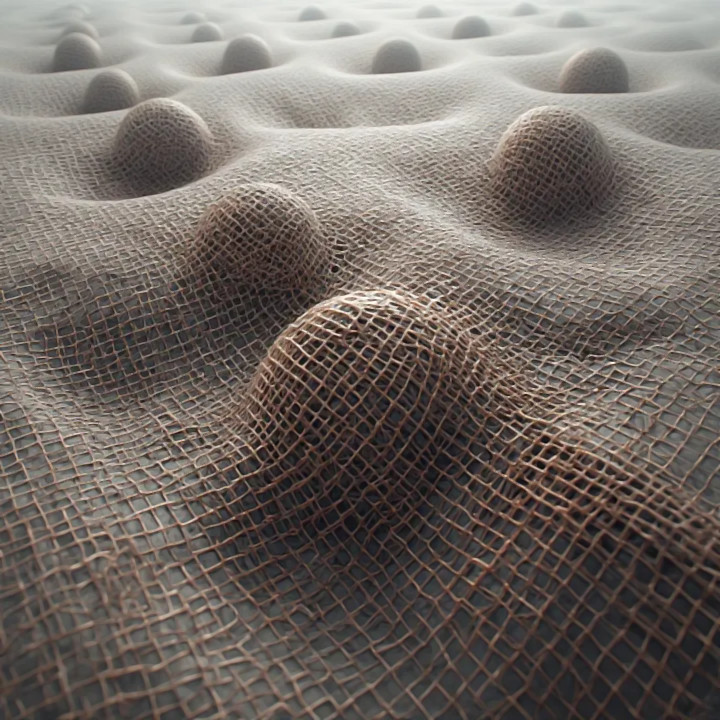
We are all familiar with the model of gravity, which is an elastic surface on which balls are placed. I just came across a model of the Higgs field that consists of a regular grid of spheres. If a particle passes freely between them, it remains massless. If it doesn’t, it pushes them apart and gains mass. And the more the particle pushes these spheres apart, the more mass it gains. The model is good, but it does not explain gravity.
I came up with the following model almost immediately.
1 approximation:
A flat surface with a stretched elastic fabric pressed against its edges. Several balls are placed underneath this fabric, lifting it. The fabric, under tension, tries to return to its original position, pushing the balls toward each other. The larger the ball, the more the fabric stretches, and if there are multiple balls, the fabric will pull them together more strongly.
The model will work even in a gravitational field, but due to friction forces only over a short distance. You can easily conduct similar experiments on your desk. Ideally, to create a model on your desk, you need to choose slippery, light, and rigid(they should not deform when pressed against the table and fabric) balls.
2 approximation:
Same thing, but with elastic net. If a ball can pass through the cells of this network, then the network cannot push it towards other, even to larger balls. This is an analogy of massless particles. Accordingly, large balls do not pass through the cells and the network brings them closer to other balls.
In reality, it is more difficult to reproduce this model on a table, so that friction forces do not interfere, a very large difference is needed between the size of the net cells and the size of the ball.
3 approximation:
Two flat elastic nets compress the balls in the absence of a gravitational field.
It’s worth remembering that this is just a model. In reality, things are much more complicated. In reality, there is no clear correlation between particle size and mass. Also, the field is not a mesh network. In general, this model, like the model of gravity on an elastic surface, is far from reality. But it can serve as a good illustration that even children can understand.