It is generally accepted that older cosmic civilizations will be more advanced. The more ancient a civilization, the greater the scale of its environmental changes, up to (but not limited to) the restructuring of entire galaxies.
But might our understanding be distorted by the rapid technological progress of the last few centuries? What if the laws of physics are finite? That is, they might one day be fully understood. And this could lead to a situation where a technological civilization, over the course of thousands of years, might reach the same level of technology as a civilization that has existed for millions of years.
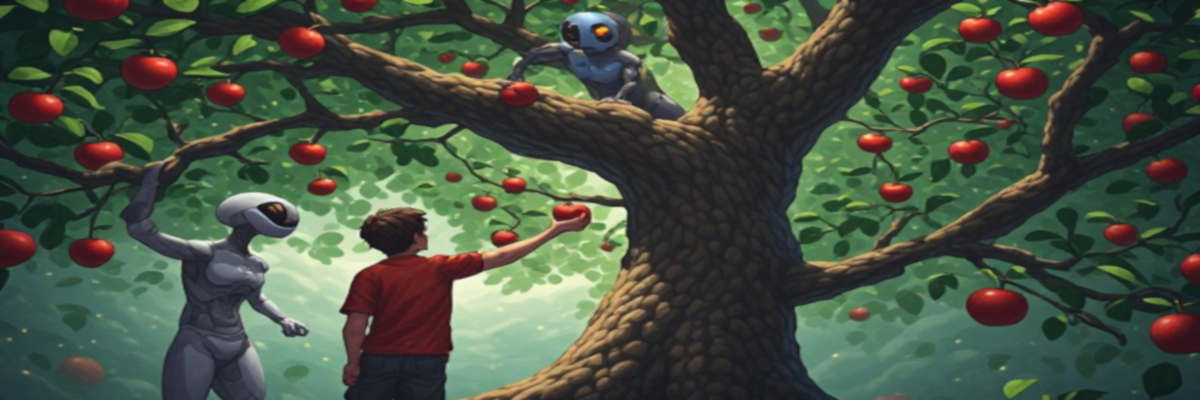
If scientific knowledge of the physical world is finite, the theory of everything can be visualized as a tree bearing fruit—a kind of "tree of knowledge." At first, people picked the fruit they could simply reach; later, they began using stands and stepladders. Then, the fruits that could be plucked from the thick branches of this tree were gathered. Now, however, the fruit remained only high up, at the ends of the thinnest branches.
Perhaps some new discovery could fundamentally change our understanding. It’s like the transition from epicycles to Galileo’s circles, and then to Kepler’s ellipses. Or like the transition from Newtonian mechanics to the Theory of Relativity.
So, will there be absolutely no differences between technological civilizations? Of course, there will be differences. But it will be expressed not technologically, but culturally. And in the level of mastery of genetic engineering and ecology.
We already know how difficult interstellar travel is. As of now, there are no realistic technologies for it—only a dream. Similarly, the laws of physics may prevent ancient technological civilizations from leaving any discernible traces across vast interstellar distances. If this is the case, then, as usual, there are two sides to it—a good one and a bad one. The good side is that it could offer an explanation for the Fermi paradox: there are no "great filters," and civilizations can potentially endure for a long time. The bad side is that interstellar travel will never become easily accessible.